Tuesday, April 24, 2012

How to Commission A Painting


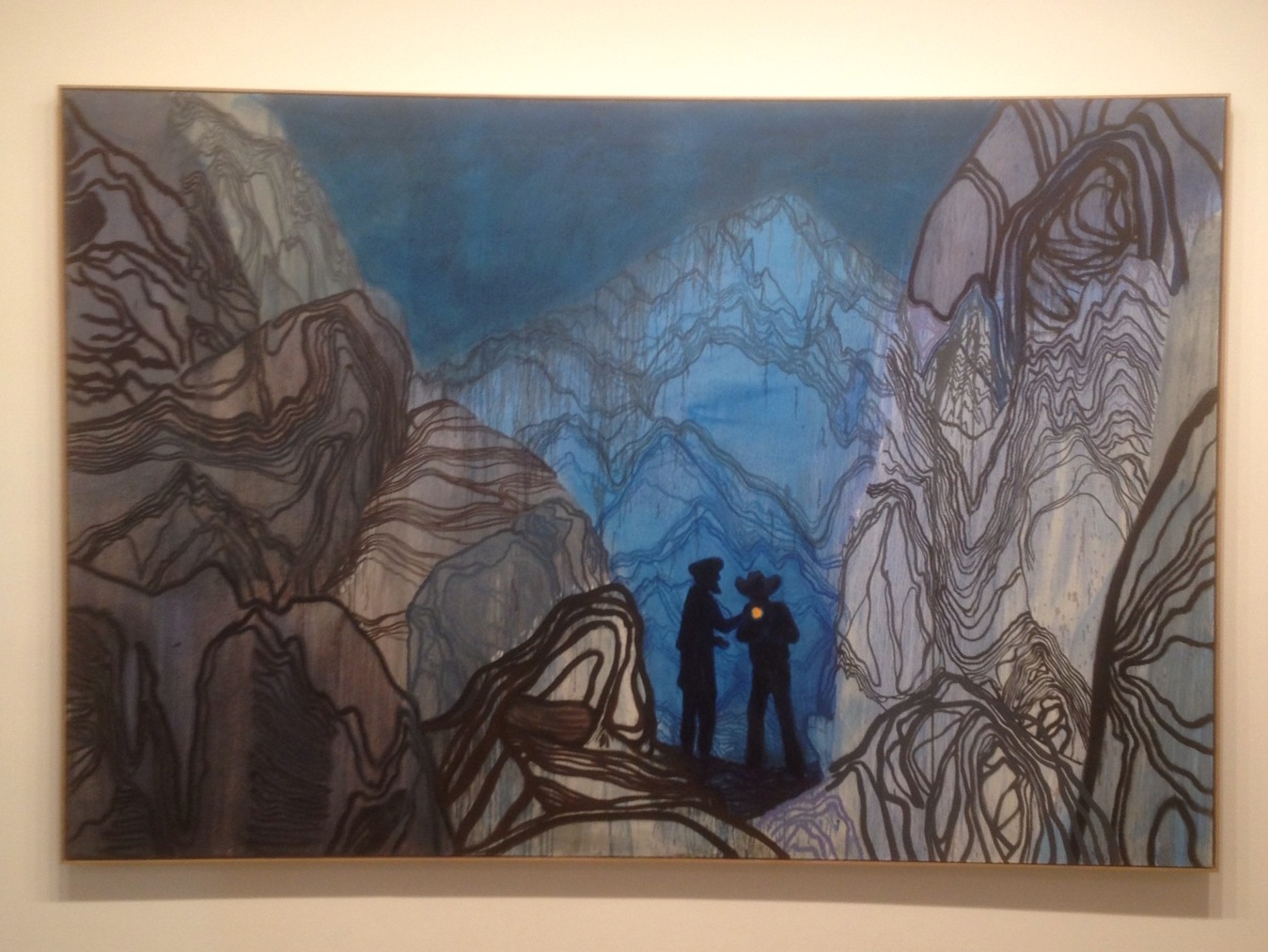
The above painting was a commission recently completed for a private collector. Creating a commission involves a fair amount of pre-production. If the person has an idea for a subject, I will use that subject and create sketches of possible compositions for a painting, such as the image below. The composition is influenced by what mood and emotions the painting should convey, as well as the anticipated size and dimensions.


Once the sketches are complete and a composition is conceived, I construct and prime the canvas to begin painting. As you can see from the above images, the sketch is just a skeleton (or blueprint) of the final painting, since my paintings usually incorporate a decent amount of abstraction.

In the example above, the collector approached me and wanted an old west landscape, 3 feet wide by 2 feet tall. That can be a broad topic, but during the early stages, he described the mood he wanted by referring to the film Saving Private Ryan - everything is on the line, a forced moment of clarity during an obscure gunfight. In sketching out the idea, I decided to play up the obscurity - the gunfight is either ongoing or has come to an end; the guy leaning on the barrel could be alive or dead; perhaps he is hallucinating; or perhaps you are the one who was shot.

Thank you for following the paintings, creations, sculpture, drawings, works in progress, Doodle of the Day, and other art by Los Angeles artist Lucas Aardvark Novak :) If you would like to explore the possibility of commissioning your own painting, feel free to contact me. Prices are determined by the square foot. To see older blog posts click HERE.

Friday, March 16, 2012

Doodle of the Day - Panda's Express Views on Pollution


I recently ordered lunch at Panda Express, that chain Chinese-food restaurant where customers should never brag about visiting. The employee asked me if I wanted it "for here" or "to go". I said, "For here," and she placed my food in the standard styrofoam container. I discovered that the only difference between "for here" and "to go" meant whether she would place the styrofoam container in a bag. After paying and receiving my styrofoam container of food, I walked to the utensil station where I noticed the napkin dispenser, as depicted above.

It puzzled me that Panda Express urged customers to conserve napkins, saying "save the environment, one napkin at a time", while at the same time providing a bulky, nondegradable styrofoam container to each and every customer on a daily basis, regardless of whether customers eat in or dine out:


It was fairly easy, if not crystal clear, to see through Panda Express's "pro-green" facade. Apparently, using less of the recycled napkins (so that Panda Express may minimize its costs), allows us to be unconcerned about the Great Pacific Garbage Patch, the vortex of floating plastics and other trash in the Pacific Ocean bigger than the size of Texas, and growing:


In any regard, the experience inspired this Doodle of the Day (click on it for larger view):


Thank you for following the Doodle of the Day and the paintings, sculpture, drawings, works in progress, reviews, and other art by Los Angeles artist Lucas Aardvark :) To see older blog posts and other doodles, click HERE.

Monday, March 12, 2012

Reasons Why Art Need Not Be Controversial In Order To Be Good

Always a topic of debate among artists is what makes good art. Recently, I have come across several opinions of artists and critics who share the theory that art must be controversial in order to be good. These people often refer to artists such as Andy Warhol in proving their point.

Recently, the finance blogger at Reuters, Felix Salmon, relied on this premise in his article: The Commodification of Gerhard Richter. Gerhard Richter is a world famous German artist (not to be confused with Daniel Richter) who has been painting since the 1950s, thriving in a wide variety of styles and subjects. Salmon's article discusses the market demands for Gerhard Richter's art and how his paintings have become commodities that now sell for millions of dollars each. But it seems the main argument of his article is that, despite its monetary value, Richter's art only holds mediocre artistic value because it is not controversial.

While Salmon's commodification analysis is sound, I disagree with his premise that good art must stir up controversy.

In making his analysis, he compares Richter to Picasso and Warhol, concluding Richter will never be in their league because Richter's work is non-controversial. Granted, Richter has painted many sentimental portraits and landscapes. Salmon makes a valid point that all of Richter's most expensive paintings could be considered "wall pleasers" (such as his colorful squeegee paintings or soothing candles), but that characteristic also applies to the work of Warhol, Van Gogh, Klimt, and Monet, to name a few. The market is a different beast from artistic merit. In determining whether Richter is as "important" an artist as Warhol, we need not review which of Richter's paintings sell for the most money.

Money aside, as it's Salmon's premise that good art must be controversial, he fails to account for Richter's portraits of the murdered nurses, the bombers, the German cityscapes after the war, and the fact that Richter never pigeonholed himself into one style. Richter also continued to stand by painting when most other artists abandoned it and declared it to be dead c.1968, as conceptualism took over. From this perspective, Richter's art can be considered controversial. Nevertheless, I don't think his level of controversy is what makes his art good. In Richter's abstract paintings, for example, he mastered the complex subtleties in layers of paint, proving that painting is intellective and more than just optical enjoyment.

Anyone today can stir controversy and subsequently label it "art". Good art is more than mere controversy.

So then what makes good art? I wish there was a concrete answer. Then I could employ it into my own creations. But if I am to express an opinion, I would say that art is measured by its level of conflict.

The difference between controversy and conflict is the difference between the "what" and the "how". A person who is not an artist will look at a work of art and ask "what is it?" Salmon does this and concludes that Richter's paintings are just colorful abstractions. Or sentimental images of candles. But an artist looks at a work of art and asks "how did he do it?" Artists intuit how the person made decisions, the thought process, why he chose the subject matter, the physical process, the layers, the illusions, the expression, the relationships, the contrasts, etc. All of this is related to conflict. It's the originality of the artist's decisions, process, and application to resolve the conflict that makes art good.

Monday, March 5, 2012

Monday, February 27, 2012

Why Abstract


February, 24" x 48", oil on canvas, 2012. (Click on image for larger view.)

It is difficult to articulate what makes abstract art attractive. But I think it is because painting does not rely on language. It transcends rationality. Abstract painting communicates without spelling everything out in logical terms.

Some people struggle to accept any type of abstract art as good art and limit themselves to pictures which represent familiar forms, such as people, landscapes, or other recognizable things. But while some paintings which represent recognizable forms can be considered good, others may still be considered bad. These same principles apply to abstract art.

An analogy could be drawn to music: some songs have lyrics which follow linear, logical thought; others have ambiguous lyrics, while still others (instrumentals) have no lyrics at all. Instrumental music still holds the potential to move people even though words don't spell everything out.

Abstract art is somewhat like instrumental music. Although anyone could pick up a brush and paint abstract, so could anyone pick up a guitar and strum an instrumental. Good instrumentals still require musicians to understand and control their instruments. Likewise, in order to create a good abstract painting, an artist is required to understand and control the paint, even if the paint is thrown or dripped on the canvas like Jackson Pollock.

I think perhaps abstract art is susceptible to the cold shoulder because we, as humans, have been trained to use our eyes to make sense of the world. From birth, we are bombarded with visuals on a daily basis and sort through the chaos by placing definitions on what we see or filing this information into familiar categories. We live in a society based on logic and reason.

Society, however, is a human construction and not an entirely truthful representation of life on Earth. Logic and reason do not encompass all experiences of living on this planet. Moreover, our eyes are highly sensitive organs (probably the most complex of our senses) trained to decipher and distinguish between slight differences in color, shade, and tone. Visual art feeds into this and becomes a form of communication through the sense of sight. Abstract art then breaks free of logical constructions, rationality, and the limitations of language - potentially becoming a form of communication on a complex level.

A painting, whether completely abstract or one with recognizable forms, is an object (not an image), with a composition and texture, a relationship of repeating and contrasting elements. In this regard, abstract painting is the same as any other form of painting. It is therefore also true that many bad abstract paintings have been created (I hope mine depicted in this post does not fall into this category, but I leave that to others to determine). That itself is insufficient reason to discount abstract painting altogether.

Painting in general has been around for a long time with a long list of masters. Our standards are high. Abstract painting is relatively young (less than 100 years old) and will eventually form a family of agreed-upon masterful works. No matter what style we consider at this point, the bottom line is: Painting is hard!

February, detail (click on image for larger view):


February, detail (click on image for larger view):


February, detail (click on image for larger view):

Friday, February 10, 2012

Doodle of the Day - Johnny Utah's Big Disappointment


The County of Los Angeles recently lifted an all-out ban on playing with footballs and frisbees on the beach, allowing for beach-goers to toss balls on beaches in Los Angeles County during the winter off-season.

But the only thing this really does is bring to everyone's attention that a law actually exists which prohibits them from playing with balls on the beach during the rest of the year! Most people, me included, had no idea there is actually a "ball playing restriction". Apparently, when you go to the beach, you're supposed to sit there like a mannequin.

County Code section 17.12.430 provides: "It is unlawful for any person to cast, toss, throw, kick, or roll any ball, tube, or any light object other than a beach ball or beach volleyball upon or over any beach..."

With the ongoing budget crisis in California, I find it hard to believe that government money will actually be spent enforcing this law. On the other hand, now everyone is actually aware that the law exists. So, Los Angeles residents, once June rolls around, watch out for the cops when you go to the beach. Or make sure to play all your football games with a beach volleyball! But don't expect to be seeing Johnny Utah.

Thank you for following the Doodle of the Day and the paintings, sculpture, drawings, works in progress, reviews, and other art by Los Angeles artist Lucas Aardvark Novak :) To see older blog posts and other doodles, click HERE.

Monday, February 6, 2012

Finalizing the Review: Matthew Ritchie v. Daniel Richter (Part 3 of 3)

In finalizing my review of the work of both Matthew Ritchie and Daniel Richter, several similarities between the two were apparent. Each painting was professionally constructed with thick (two-inch) stretcher bars and high quality canvas or fine linen. As should be expected from such acclaimed painters, their work viewed from all angles has a professional and finished quality in terms of construction and craftsmanship, even though their painting techniques may appear haphazard and rapid.

In their techniques, each artist uses numerous layers of thin washes. This creates an illusion of depth on the flat plane of the canvas, providing both strong and subtle fluctuations and variations in the paint, creating complexities in the overall completion of the painting. This gives the effect that the canvas is a window to a stage, even though the paintings still contain abstract elements. In a sense, their work combines the flatness of early abstract art with the three dimensional illusion of pre-impressionist art:


With respect to the artistic experience, however, their works differ. While Richter comments on current politics, corruption, and warfare, Ritchie explores the nature of human existence.

Richter’s work provides a critical view of world powers, making statements about world leaders…


…while Ritchie’s work has a more organic feel, asking questions and trying to make sense out of life:


As a whole, I thought Richter’s paintings were more interesting than Ritchie’s. This was not because of the subject matter. And as described in my last post, the paintings were not entirely impressive. But it was because, for the most part, Richter’s application of layers created more complexities and subtleties in the paint. And when viewing the paintings as a group, Richter’s provided more of a sense that each painting was unique, whereas Ritchie’s paintings felt that, if you’ve seen one, you’ve seen them all.

But while Richter only exhibited paintings, Ritchie’s exhibition differed in a positive way by incorporating different media, unifying painting, sculpture, animation, and installation in creating an entire environment within the exhibition space. The ambiguity of Ritchie’s work, his motivation and ideas, served to be more thought-provoking and prompt more questions than some of the spoon-fed statements of Richter.

For these reasons, I cannot say that I enjoyed Richter’s exhibition more than Ritchie’s. Each exhibition was an inspirational artistic experience, with aspects to embrace and some to reject.

Thanks for reading. Hope you're enjoying the reviews, paintings, creations, sculpture, drawings, works in progress, Doodle of the Day, and other art by Los Angeles artist Lucas Aardvark Novak :) To see older blog posts click HERE.