Showing posts with label artistic. Show all posts

Monday, September 24, 2012

The Muse: Sex, Procreation, And Inspiration

The Voyage, 13.5" x 60", oil on canvas, 2012.

Paint is like the skies or the seas. It is the job of the painter, like a pilot, to understand it, embrace it, and navigate through it. Paint is open, free, and limitless; it can be calm one moment or stormy the next. Paint is like mother nature, and the painter is man trying to bring some control to it.

And on a smaller scale, paint is like a woman. It is the job of the painter to lead the dance and give her the opportunity to express herself in all of her beauty and grace.

The Voyage, left detail:

In reality, of course, paint is just a medium. But the metaphor is also real and I think a reason why the muse has become like a mythical goddess inspiring artists since ancient times. The muse creates an overwhelming desire in the artist to replicate her incommunicable effect through art. Painting, like poetry or music, is the artist's way of attempting to bring some control to her storm of emotions, to make sense of the ungraspable. She is in the paint, and the painter is seeking to find her, recreate her, love her, and allow her to express herself. 

I have inquired in the past about why we make art. What's the point, right, since art doesn't appear to fulfill any physiological need. But maybe it does, on a subconscious level, for the artist at least. Artistic inspiration is often derived from a muse of some kind, even if the muse is someone who has no idea the effect she is creating. (It seems that the stereotypical muse is someone who has a personal relationship with the artist, as in a mistress, but in my experiences, I have found that many times the muse is someone who remains distant, even if our connection is fleeting -- not all of us artists are womanizers like Picasso -- and sometimes the most fleeting encounters carry the most mystery and intrigue.) So, perhaps art is a form of the innate drive to procreate. I don't mean to say that every artist desires to have kids, nor do I agree with the Freudian concept that all art is sexual in nature, as certainly art can be inspired by other things, like death, struggle, and inequality, yet the urge to procreate in its most primitive form can be enough to inspire an artistic masterpiece.

The Voyage, middle detail: 

But artistic inspiration from the muse is not limited to sexual energy. She is representative of the beautiful things we may discover in nature but cannot grasp, and her energy blooms within the artist, creating within him the desire to give his love to the world.
 
And because mother nature will never be conquered by man, it is a reason why painting will live on forever.

The Voyage, right detail: 

Tuesday, September 18, 2012

New Season and New Sculpture


The Head of Something Unreal, 20" x 15", acrylic on shaped foam, canvas, and epoxy resin with steel armature and steel chain, mounted on wood panel, 2012. (Click on the image for larger view.)
 
It's been a while since I've created any sculptures, but sometimes it comes in waves, just like my cartoons and stop motion videos, where I may not work in that medium for months or years, then something clicks and I immerse myself in it until it runs its course, or season. Certain mediums may be more effective than others in artistic expression. The choice of medium itself provides content in a work of art.

In this piece, the content is something more metaphorical than the simple representation of skull pieces from some strange beast. The artwork is somewhat of a hybrid between representation and abstraction.

I'm not trying to be cryptic about what it is, or what it is supposed to be. And I know that nobody will really understand it or me. In that regard, it makes what I do a bit frustrating. But we as artists create art as a form of communication that cannot be expressed in language. If it could be expressed in language, then there would be no point in creating it, as we could simply resolve to writing it.

There's nothing more to write.

Monday, August 27, 2012

Art, Life, and the Pendulum

The Pendulum, 39" x 60", oil on canvas, 2012. 


DJ Pauly D is famous. He made millions of dollars as a character on MTV's reality show Jersey Shore, and he makes millions as a DJ. And like most pop music, his songs have catchy beats and straight-forward lyrics: "I've partied all over the world, but not like this/ This is the night of my life, this is the night of my life..." Fun stuff, I guess.

But I don't consider DJ Pauly D to be an artist. He is a successful businessman and entertainer. His songs, like most pop songs, grab your attention immediately and are easy to understand, like the bling hanging around his neck. The music gets people to take tequila shots, bounce around, and forget about everything.

Likewise, a painting with bright colors, such as the work by Thomas Kinkade (rest in peace) is catchy on its surface and has a decorative charm. But life is not always so happy and innocent, and real art, to me, is not so simple or superficial. Real art should move people on a deeper level.  

Life is full of complexities, subtleties, ambiguities, and contradictions.  This seems to be who we are as people, as it is apparent in each of our individual personalities, and even as we try to make rational sense of the external world, it too is full of irrationalities. It is layers and levels; it is dark and disturbing, or it is bright and joyful; it is hot, or it is cold; it is high, or it is low. 

What keeps a viewer's eye on a painting is a depth of field, an inexpressible ambiguity, a suggestive subtlety, a surreal complexity. Good art should represent the depths of our souls.

The Pendulum, detail:


The Pendulum, detail:


The Pendulum, detail:


Thank you for reading about the paintings, sculptures, drawings, works in progress, reviews, Doodle of the Day, and other art by Los Angeles artist Lucas Aardvark Novak. To see older blog posts and other doodles, click HERE :)

Friday, July 20, 2012

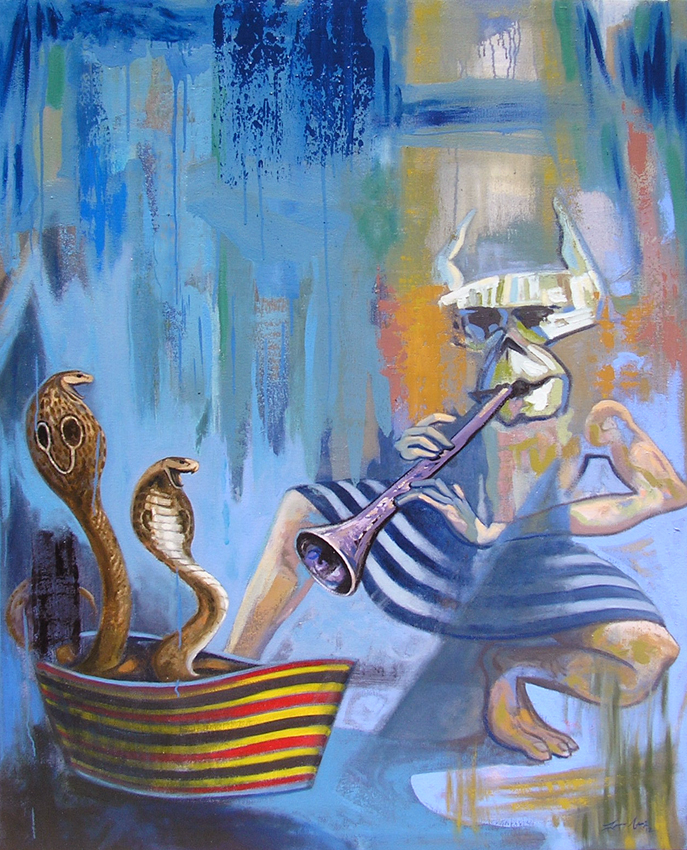
New Work, Nietzsche And The Snakecharmer

When I was a kid I wanted to be a snakecharmer. Something about the danger, society's unexplained phobia, and the mystery of snakes enchanted me. I roamed the California hillsides looking for snakes and found several. Somehow I avoided the toxins of rattlers and only suffered superficial bites from nonvenomous serpents.

Years later I remain enchanted by snakes, but I suppose it is of a more distant respect for them. They remain mysterious. What they represent symbolically or metaphorically to people and in art and literature, throughout the centuries of our existence, continues to fuel my intrigue for the creatures.

Snakes have been the subjects in art around the world since primitive times. What is it about snakes that has bewitched our cultures? Perhaps it is that snakes are primitive. But I think it is also more than just that - snakes are symbolic of the truth.

Friedrich Nietzsche wrote: "The truth is ugly: we have art so that we are not ruined by the truth."


The Snakecharmer, 45" x 36.5", oil on canvas, 2012.

The following are details of the painting, click on image for larger view:


And this is what the painting looked like at a very early stage:


Thank you for reading about the paintings, sculptures, drawings, works in progress, reviews, Doodle of the Day, and other art by Los Angeles artist Lucas Aardvark Novak. To see older blog posts and other doodles, click HERE :)

Friday, July 6, 2012

New Work, and the Kandinsky Observation


Metamorphosis, 25" x 40", oil on canvas, 2012.

The great Wassily Kandinsky once stated: "The true work of art is born from the 'artist': a mysterious, enigmatic, and mystical creation. It detaches itself from him, it acquires an autonomous life, becomes a personality, an independent subject, animated with a spiritual breath, the living subject of a real existence of being."

Kandinsky's convictions are most easily demonstrated when visiting museums - certain works of art seem to be human and radiate immortality. These are the timeless pieces that have transcended subjective appeal, becoming globally accepted as great works of art over the decades and centuries.
 
Over the past decade of art making, I have felt that my own creations have detached themselves from me and taken on their own lives and personalities. I operate like I am a portal and allow the work to be completed through me, taking on its own form and making its own conclusions, even if I begin the painting with a vision of what I think the end product should be.  But rather than the Heavenly "mysterious, enigmatic, and mystical creations ... animated with a spiritual breath", perhaps my creations can be better described as little monsters, rejects, or riffraffs.

It fulfills the creative drive nevertheless.

Metamorphosis (detail):

Metamorphosis (detail):

Thank you for reading about the paintings, sculptures, drawings, works in progress, reviews, Doodle of the Day, and other art by Los Angeles artist Lucas Aardvark Novak. To see older blog posts and other doodles, click HERE :)

Thursday, June 28, 2012

Review of an Inspirational Painting - Picasso's Woman of Majorca


Every so often I come across an inspirational painting. This time I was struck by Pablo Picasso's Woman of Majorca, pictured above. He painted it in 1905, when he was 24 years old. Exactly 100 years later, I was 24 years old, and part of the intrigue for me anytime I view a painting by Picasso is to look at the date of creation and dare to compare what he accomplished at my age.

I'm not trying to be Picasso, nor do I have the arrogance to think I have his level of artistic talent, but sometimes I do come across a piece of his work, realize I have 5 or 10 or 20 years to create something just as good, and get a boost of confidence that yes, it can be done - Picasso was not a god; he was just a man. But in the case of Woman of Majorca, Picasso's mastery is clear, and attempting to describe such mastery in words is probably futile, even if your name is William Faulkner.

Certainly there are art historians, professors, and critics who can write an academic informative review of Woman of Majorca, theorize about why Picasso chose this subject matter, while comparing his transition from the "blue period" to the "rose period" at this time of his life. I don't plan to do that, and I'm sure Mr. Picasso didn't sit down one day and say to himself, "Today I'm beginning my rose period, so now my palette needs to look like this..." He just painted what felt right. So I will attempt to articulate why it feels right to me.


Woman of Majorca resonates an ambiguous, mysterious quality. It doesn't matter that the subject matter is simply a portrait of a woman; perhaps the simplicity of the portrait adds to its mysteriousness, similar to the eroding ancient Roman, Greek, Egyptian, Pre-Columbian, and Asian sculptures. Her eyes reveal nothing, as they are just black ovals devoid of any white, yet the eyelids are relaxed and seem to alleviate any evilness that might otherwise be conveyed by black eyes. The ambiguity in her face is further demonstrated by its relative flatness in neutral color, with minimal modeling, wrinkles, and lines. And although this ambiguity risks being dismissed as a boring lack of detail, Picasso frames the face with a hat on top, veil on the sides, and V-neck and hand from below, to remind the viewer that the face is the focal point - to encourage the viewer to keep studying it because there is more to be discovered.

The sketchy quality, angular shapes, and lack of refinement reveals Paul Cezanne's influence on Picasso. And it seems to me that Picasso had probably seen a woman in town, a stranger or an acquaintance, and as he was inspired by a momentary glimpse of strange melancholy, he later returned to his studio to recreate her from memory - details clouded and ambiguity conceived, as he sought to quickly convey his feelings to the canvas. 
 
Picasso applied the paint in a deliberate confident way, unconcerned about photorealistic qualities. And the ambiguity creates timelessness because it is a nonspecific woman with an obscure gaze; we don't know what she is thinking. We cannot understand her. Yet the painting is somehow inexplicably human. Like the Mona Lisa.

Apparently, Woman of Majorca was simply meant to be a study for a figure to be included in a much larger painting: Les Bateleurs, also created in 1905, depicted below. As you can see, the woman in the bottom right is in a very similar pose. While both paintings still present a level of melancholy, I feel that the masterful impact of Woman of Majorca is lost in her representation in Les Bateleurs, albeit she is not the primary subject. I must also add that my judgment of Les Bateleurs is limited to my perception of its reproduction as an image on a computer screen, certainly an adulterated experience when the size of the actual artwork is an enormous 83" x 89".


Thank you for reading about the paintings, sculptures, drawings, works in progress, reviews, Doodle of the Day, and other art by Los Angeles artist Lucas Aardvark Novak. To see older blog posts and other doodles, click HERE :)

Wednesday, June 6, 2012

Top 5 Ways To Be A Better Artist

I don't typically create lists of stuff, though maybe it's something I should do more often, like for going to the grocery store or getting errands done, rather than wandering around aimlessly with an annoying thought in my skull that I'm forgetting something, like having a rock in my shoe. When it comes to artistic creation, sometimes lists are good - they can serve as reminders, or directionals, as you meander through the unexplored wilderness.

 
The Revenant, 37" x 48", oil on canvas, 2012.

So, here is a list I made of the top 5 ways on how to be a better artist. It's by no means an effort to preach to the world. I ain't standing on any platform, and I ain't sayin it's true for everyone. I'm simply setting a series of markers for myself in this labyrinth... 
 
Number 1: Be prolific. An artist must always keep working. The idea is similar to an athlete going to the gym or taking hundreds of swings in the batting cage. It is indeed okay to take some time off (and probably required), but when the season is in session, an artist must be 100% dedicated and all in. Slumps do happen, and at times it feels that art is pointless or your efforts are futile, but it's not an excuse to stop working. Ask yourself, "How bad do I want it?" The answer should be simple. An artist must continue to work through hard times.

 The Revenant, (detail):
 

Number 2:. Craftsmanship matters. Some conceptual artists have almost entirely eliminated the craft from their work, even attempted to distinguish the "high" artist from the "lowly" craftsman. But I believe good art, even conceptual art, still requires a certain high level of craftsmanship. An artist must pay attention to every detail in his work. This does not mean that every work of art needs to be realistic or appear pristine, but there can be no mistakes in the final piece. Regarding painting, I think good craftsmanship requires an advanced ability to draw, even if the artist is creating work that is completely abstract or expressionistic. Drawing practice is basically the training of hand-eye coordination to create exactly what you want, rather than hoping something interesting develops haphazardly, even if the finished style appears random, dirty or gestural.

The Revenant, (detail):
 

Number 3: Study all subjects, not just art. In the early 20th century, United States Supreme Court Justice, Felix Frankfurter, was asked by a young man how to become a great lawyer.  He advised the young man not to limit his studies to the law, but to embrace the study of all fields, including history, art, literature, science, sports, other cultures, the economy, and the environment. I believe Justice Frankfurter’s wisdom applies to those who wish to become great artists. Art represents culture, and these other fields of study embody who we are on this planet.

Globalization continues to develop and refine a global culture, thus artists should think globally. The timeless pieces of the past are those which appeal to populations everywhere. Artistic creation is an ongoing practice and lifelong study, and this study encompasses all fields which make up the global population.

The Revenant, (detail): 

Number 4: Continue to develop your taste in art. By taste, I am referring to the ability to make comparative judgments of art. The more a person develops his taste, the more objective he becomes in his analysis. Often times a person will disregard certain types of art, declaring, "I know what I like, and it's not that." Such a mindset gives the person an excuse to remain close-minded, essentially reaching a plateau in his appreciation of artistic experiences. While it is obviously acceptable to dislike certain works, an artist should always keep an open mind and continue to refine and develop his taste in art by studying other artists, attending exhibitions and museums, and expanding his life in general by studying all fields, as discussed in Number 3 above. Just try not to be snobbish or pretentious about it.

Number 5: Stick with your own voice. This one probably sounds cliche, but it is true and easy to forget. It is easy for an artist to be influenced by the work of famous artists who are successful monetarily. But the attempt to imitate others usually results in banal and stifled work. The challenge for any artist is to bring something game-changing and new to the table. This can only be done by sticking with the artist’s own voice, and standing by his work, even when others criticize it. 

An artist must continue to develop his own voice, just like continuing to develop his own taste and continuing to study other fields. The more the artist develops his taste, the less likely he will be to try to imitate others, and the more likely he will be to venture into unexplored territory. On the flip side, simply creating work that people expect, or that appeals to the artist’s past collectors, his critics, or people he knows, will certainly result in stagnant, repetitive art. No matter what an artist creates, there will always be people who criticize it. An artist must simply remember to stay true to himself.

Thank you for reading about the paintings, sculptures, drawings, works in progress, reviews, Doodle of the Day, and other art by Los Angeles artist Lucas Aardvark Novak :) To see older blog posts and other doodles, click HERE.